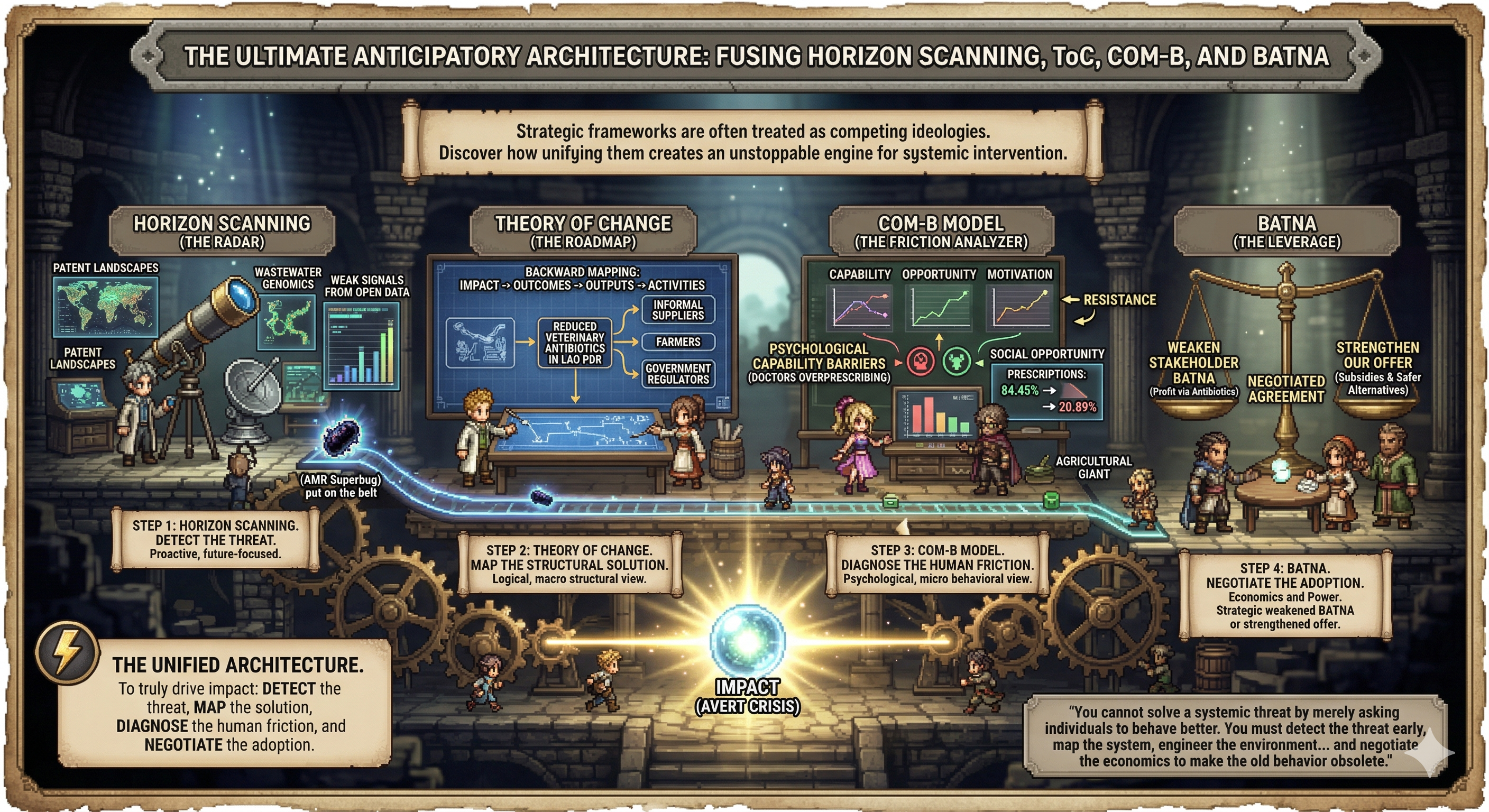
Strategic frameworks are frequently treated as competing ideologies. Program evaluators debate whether to use the Theory of Change or Logical Frameworks. Behavioral scientists argue for the COM-B model. Negotiators swear by BATNA. Foresight analysts rely entirely on Horizon Scanning.
The truth is, none of these frameworks are sufficient on their own when confronting complex, systemic crises. They are not competing ideologies; they are consecutive gears in a single engine of anticipatory strategy.
The Unified Architecture
To truly drive impact, organizations must detect the threat (Horizon Scanning), map the structural solution (Theory of Change), diagnose the human friction (COM-B), and negotiate the adoption (BATNA).
Step 1: Horizon Scanning (The Radar)
Before you can change a system, you must know what is coming. Horizon scanning acts as the strategic radar. By analyzing patent landscapes, wastewater genomics, and weak signals in open-source data, analysts can detect disruptions years before they manifest in mainstream policy. It transitions an organization from reactive crisis management to proactive anticipation.
Step 2: Theory of Change (The Roadmap)
Once a threat is detected, the Theory of Change (ToC) provides the structural roadmap. It forces policymakers to work backward from the desired Impact (e.g., averting a crisis) to the specific Outcomes, Outputs, and Activities required to achieve it. ToC ensures that interventions are logically sound at the macro level.
Step 3: The COM-B Model (The Friction Analyzer)
A Theory of Change assumes that if you build the infrastructure, people will act rationally. They rarely do. The COM-B Model (Capability, Opportunity, Motivation) is applied specifically to the 'Outcomes' tier of the ToC to diagnose exactly why the target audience might resist the change. It pinpoints the psychological and environmental bottlenecks.
Step 4: BATNA (The Leverage)
Even if people have the Capability and Opportunity to change, their Motivation often depends on economics and power. BATNA (Best Alternative to a Negotiated Agreement) defines the leverage. If a stakeholder's alternative to adopting your intervention is highly profitable, no amount of behavioral nudging will work. You must strategically weaken their BATNA through regulation or strengthen your offer through subsidies.
The Unified Strategy Architecture
1. Detect
Horizon Scanning
2. Map
Theory of Change
3. Diagnose
COM-B Model
4. Negotiate
BATNA
Figure 1: The Unified Flow of Anticipatory Strategy—from signal detection to stakeholder negotiation.
Real-World Case Study: The Global Antimicrobial Resistance (AMR) Crisis
To see this unified architecture in action, we look at one of the greatest existential threats of our time: Antimicrobial Resistance (AMR). By 2050, drug-resistant "superbugs" are projected to cause 10 million deaths annually [1]. How is the global health community using this 4-step framework to fight it?
| Phase | Framework | Application in Combating AMR |
|---|---|---|
| 1. Detect | Horizon Scanning | Public Health agencies use environmental scanning (e.g., wastewater surveillance) and patent data mining to detect emerging resistance patterns and novel pathogen outbreaks before clinical cases surge. |
| 2. Map | Theory of Change | Agencies map the supply chain. For example, a pivotal ToC study in Lao PDR identified that reducing veterinary antibiotics required specific structural outcomes connecting informal suppliers, farmers, and government regulators [PubMed: 33965370]. |
| 3. Diagnose | COM-B Model | Why do doctors overprescribe? A milestone study applied COM-B to dental surgeons. By addressing specific Psychological Capability and Social Opportunity barriers, they successfully reduced prophylactic antibiotic prescriptions from 84.45% down to 20.89% [See related AMR Behavioral Studies on PubMed]. |
| 4. Negotiate | BATNA | Agricultural giants have a strong BATNA: "Keep using antibiotics to ensure livestock yield and profit." Global health initiatives must alter this by shifting the economics—introducing strict regulations on antibiotics (weakening their BATNA) while subsidizing safer alternatives (improving the negotiated agreement). |
"You cannot solve a systemic threat by merely asking individuals to behave better. You must detect the threat early, map the system, engineer the environment to support the new behavior, and negotiate the economics to make the old behavior obsolete."
Conclusion
The era of siloed strategic thinking is over. A Horizon Scan without a Theory of Change is just anxiety. A Theory of Change without COM-B is just a wish. And behavioral interventions without BATNA leverage will be crushed by market economics. By unifying these four frameworks, organizations can move from reactive observation to true strategic dominance.