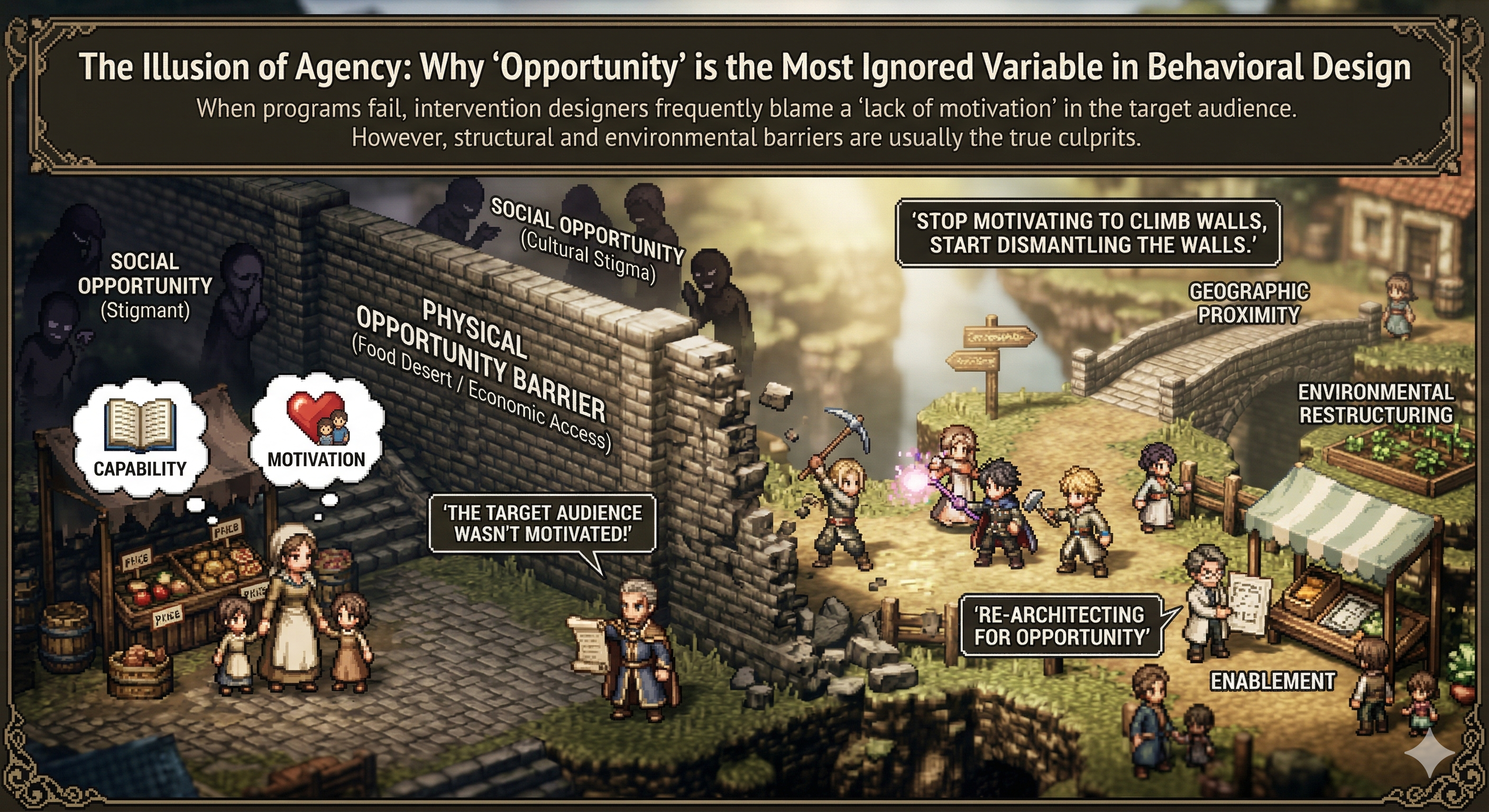
When a public health campaign fails to increase healthy eating, or a corporate compliance program fails to change employee habits, the post-mortem analysis usually points to a single, convenient scapegoat: The target audience just wasn't motivated enough.
This assumption is not only lazy; it is statistically and scientifically dangerous. In the COM-B model of behavior change, behavior is generated by the interaction of Capability (C), Opportunity (O), and Motivation (M). Yet, time and again, intervention designers hyper-focus on Motivation (through marketing and persuasion) and Capability (through training), while entirely ignoring the heaviest anchor of all: Opportunity.
The Two Faces of Opportunity
In the COM-B framework, Opportunity is defined as the external factors that make a behavior possible or prompt it. It is strictly divided into two sub-categories:
1. Physical Opportunity: This is the tangible environment. Does the person have the time, the financial resources, the physical access, and the geographic proximity to perform the behavior?
Example: You cannot motivate a family to eat fresh vegetables if they live in a food desert where the nearest grocery store is 10 miles away and they lack reliable transportation.
2. Social Opportunity: This is the cultural and interpersonal environment. Do the social norms, peer pressures, cultural stigmas, or legal structures allow the behavior?
Example: An employee might have the software skills (Capability) and desire (Motivation) to use a new, transparent reporting tool, but if the unwritten corporate culture punishes whistleblowers (Social Opportunity), the behavior will not occur.
The Danger of the "Vacuum" Theory of Change
Many traditional Theory of Change (ToC) maps are drawn in a vacuum. They chart a path from Input → Activity → Output → Outcome, assuming a frictionless environment.
By ignoring Opportunity, organizations fall into the trap of "victim-blaming." They launch educational campaigns telling low-income mothers to feed their children expensive proteins, and when the data shows no change in stunting metrics, the program evaluators conclude that the mothers "failed to adopt the learnings."
A proper COM-B diagnostic would reveal that the mothers had high Motivation (they love their children) and high Capability (they understood the nutritional training), but zero Physical Opportunity (eggs are economically out of reach). The correct intervention was never an educational workshop; it was an economic subsidy or a structural redesign of the local food supply.
Re-Architecting for Opportunity
If your COM-B analysis reveals that Opportunity is the bottleneck, your intervention strategy must pivot drastically away from communication and toward environmental design.
This means utilizing interventions like Environmental Restructuring (changing the physical context), Restriction (using rules to reduce the opportunity to engage in competing behaviors), or Enablement (increasing means and reducing barriers).
We must stop trying to motivate people to climb over walls, and start using our resources to dismantle the walls instead.