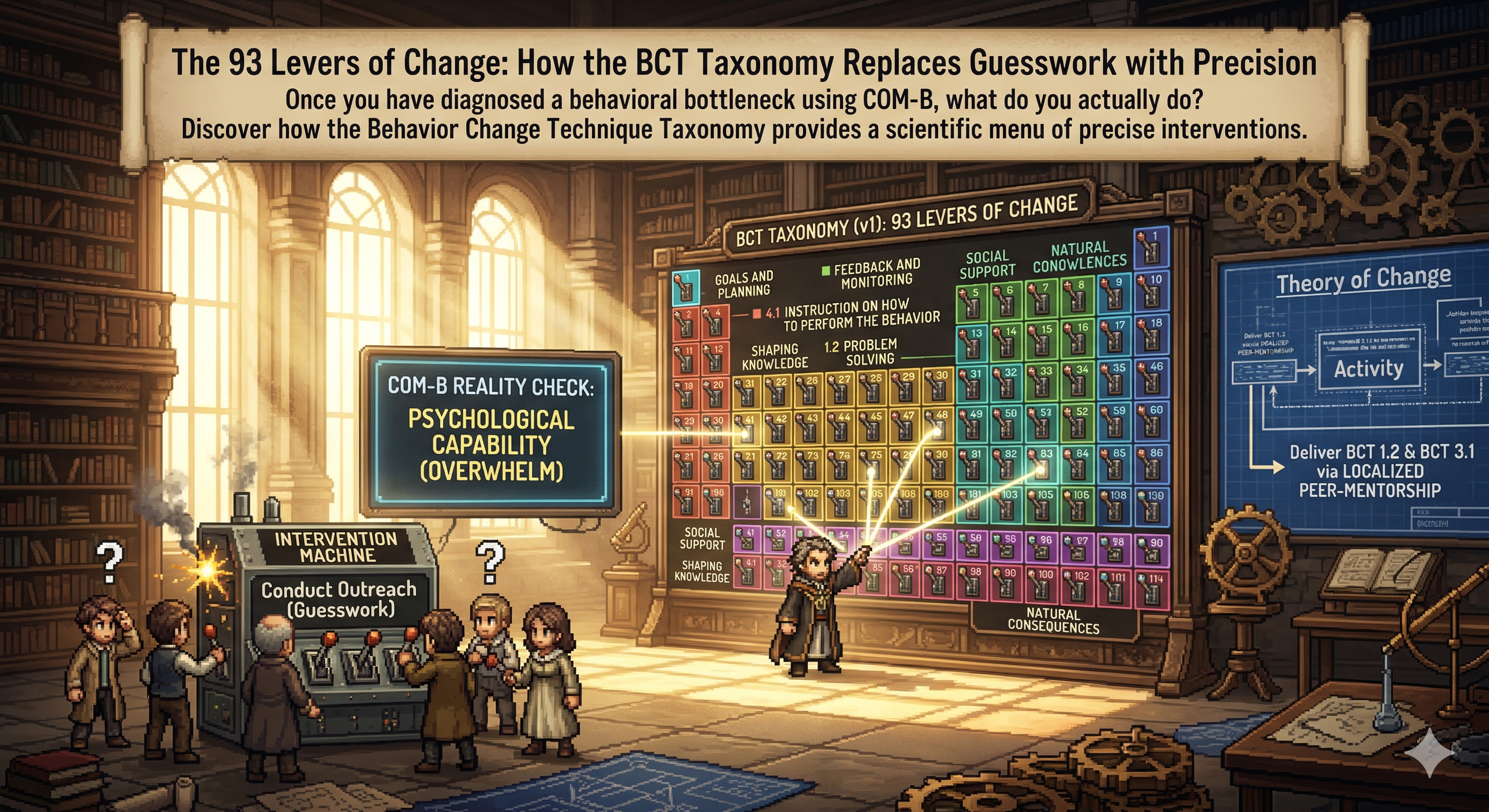
You have built a rigorous Theory of Change. You have stress-tested your Outcomes using the COM-B model. You discovered that your target audience is failing to adopt a new digital tool not because they lack Motivation or Opportunity, but because they lack Psychological Capability—specifically, they find the new interface overwhelming and lack the mental stamina to learn it.
The diagnosis is precise. But now comes the hardest part of intervention design: What exact Activity do you build to fix it?
Historically, program designers would simply guess. They would organize a "training session" or create a "how-to manual." But in 2013, the architects of the COM-B model, led by Susan Michie, revolutionized this process by publishing the Behavior Change Technique Taxonomy (v1).
What is the BCTTv1?
The Behavior Change Technique Taxonomy (v1) of 93 Hierarchically Clustered Techniques is essentially the periodic table of behavior change. The researchers reviewed hundreds of behavioral interventions across disciplines and isolated 93 distinct, observable, and replicable "active ingredients" that cause behavior to shift.
These 93 techniques are clustered into 16 distinct groups, such as:
- Goals and Planning (e.g., Goal setting, Action planning)
- Feedback and Monitoring (e.g., Self-monitoring of behavior)
- Social Support (e.g., Practical social support)
- Shaping Knowledge (e.g., Instruction on how to perform the behavior)
- Natural Consequences (e.g., Information about health/environmental consequences)
Linking COM-B to the Taxonomy
The true power of the BCT Taxonomy is unlocked when it is explicitly mapped to your COM-B diagnosis. You no longer have to guess which intervention to use; the framework dictates the highest-probability interventions based on the specific barrier.
If your COM-B diagnosis points to a lack of Physical Capability, the taxonomy guides you away from "Information" and toward BCTs like Demonstration of the behavior or Behavioral practice/rehearsal.
If the bottleneck is Automatic Motivation (e.g., the target audience has a deep-seated habit of doing things the old way), giving them a manual will fail. Instead, the taxonomy points you to BCTs like Habit reversal, Prompts/Cues, or Incentive design.
Moving from Abstract to Observable
The most significant advantage of utilizing the 93 BCTs in your Theory of Change is that it forces your "Activities" layer to become highly specific and observable.
Instead of writing a vague Activity like "Conduct outreach," you define the Activity by its active ingredients: "Deliver BCT 1.2 (Problem Solving) and BCT 3.1 (Social Support) via a localized peer-mentorship program."
This level of precision fundamentally transforms Monitoring and Evaluation (M&E). When a program fails, you no longer have to wonder if the whole concept was flawed. You can look at the specific BCTs deployed and ask: Did we execute the wrong technique, or did we execute the right technique poorly?
By integrating the BCT Taxonomy into the ToC workflow, we replace the "art" of guessing with the "science" of behavioral engineering.