Let’s start with an uncomfortable truth: when something fails, it is not because the world is unfair. It is because something in our model was wrong.
Not incomplete. Not unlucky. Wrong.
And that is not a bad thing.
Because once you accept that, failure transforms from something emotional into something analytical.
The Myth of "Trying Harder"
We are often told to persist. To try again. To not give up.
But persistence without diagnosis is just repetition.
Doing the same thing 1000 times without understanding why it failed is not resilience—it is blindness.
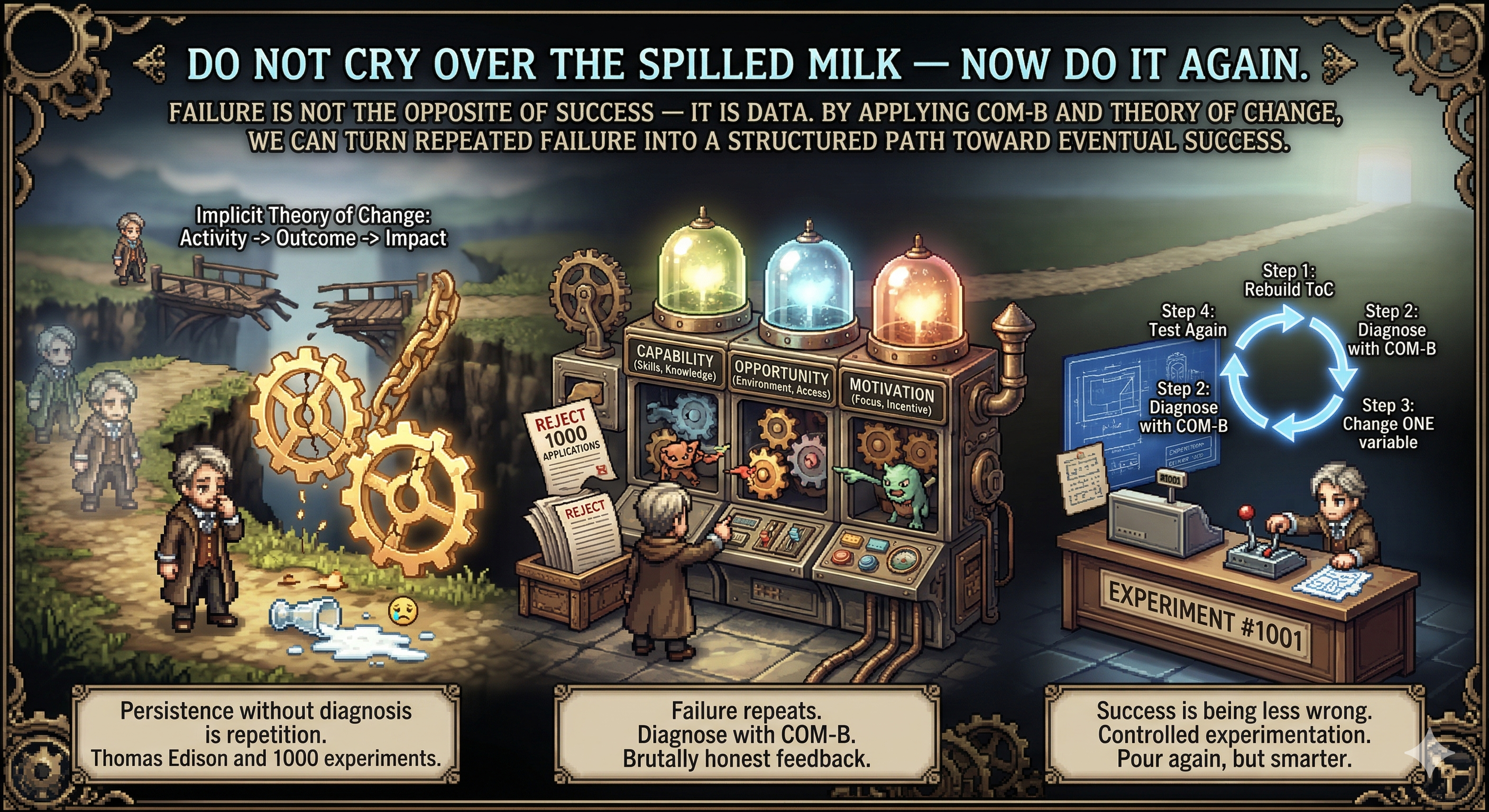
Thomas Edison did not "fail" 1000 times to invent the light bulb. He ran 1000 experiments. Each iteration eliminated a wrong assumption.
That is the difference.
Failure is a Broken Theory of Change
Every action we take—whether applying for a job, launching a project, or designing a policy—is based on an implicit Theory of Change.
We assume:
- If I do X (Activity)
- Then Y will happen (Outcome)
- Which leads to Z (Impact)
When we fail, it means one of these assumptions is broken.
But most people never go back to inspect the chain. They simply try again—with the same flawed logic.
This is why failure repeats.
Enter COM-B: The Failure Diagnostic Engine
If Theory of Change tells you what should happen, the COM-B model tells you why it did not happen.
Every failed outcome can be traced to one of three variables:
- Capability: Did you actually have the skills, knowledge, or capacity?
- Opportunity: Did the environment allow it to happen?
- Motivation: Did the system (or people) have enough incentive to act?
This is where things become brutally honest.
Because most failures are not about effort. They are about misdiagnosis.
A Personal Reality: 1000 Applications
Let me make this real.
Thomas Edison needed 1000 attempts to make a light bulb.
I needed 1000 attempts to get into the United Nations.
And to be honest? I am still applying.
But here is the difference: I am not repeating the same application.
I am iterating.
Each rejection is not emotional damage—it is feedback.
Each failure forces a question:
- Was my Capability insufficient? (skills, experience, narrative)
- Was my Opportunity misaligned? (timing, network, access)
- Was my Motivation signal weak? (how I positioned value)
Every iteration adjusts one variable.
That is how failure becomes progress.
From Failure to Strategy
This is where Theory of Change and COM-B become powerful together.
Step 1: Rebuild Your Theory of Change
Do not assume your original path was correct. Redesign it.
Step 2: Diagnose with COM-B
Identify exactly where the breakdown happened.
Step 3: Change One Variable
Do not change everything. Change the right thing.
Step 4: Test Again
Run the next iteration with intention.
This is not "trying again."
This is controlled experimentation.
The Emotional Trap
The biggest danger in failure is not the failure itself—it is the emotional response.
People take failure personally. They internalize it. They hesitate.
But systems do not care about your feelings. They respond to structure.
If you treat failure as identity, you stop.
If you treat failure as data, you improve.
Do Not Cry. Recalculate.
"Do not cry over spilled milk" is incomplete advice.
You should not cry—but you should analyze why the milk spilled in the first place.
Was the glass unstable? (Opportunity)
Was your grip weak? (Capability)
Were you distracted? (Motivation)
Fix the variable.
Then pour again.
Conclusion: The Discipline of Iteration
Success is not about being right the first time.
It is about being less wrong over time.
COM-B gives you the diagnostic lens.
Theory of Change gives you the structural map.
Together, they turn failure into a system.
So no—do not cry over the spilled milk.
You were already wrong.
Now do it again. But smarter.