The landscape of social impact, corporate strategy, and public policy is littered with brilliant ideas that failed in execution. We build schools, but attendance remains low. We distribute health applications, but users abandon them after a week. We run extensive training workshops, yet workplace habits remain unchanged. Why?
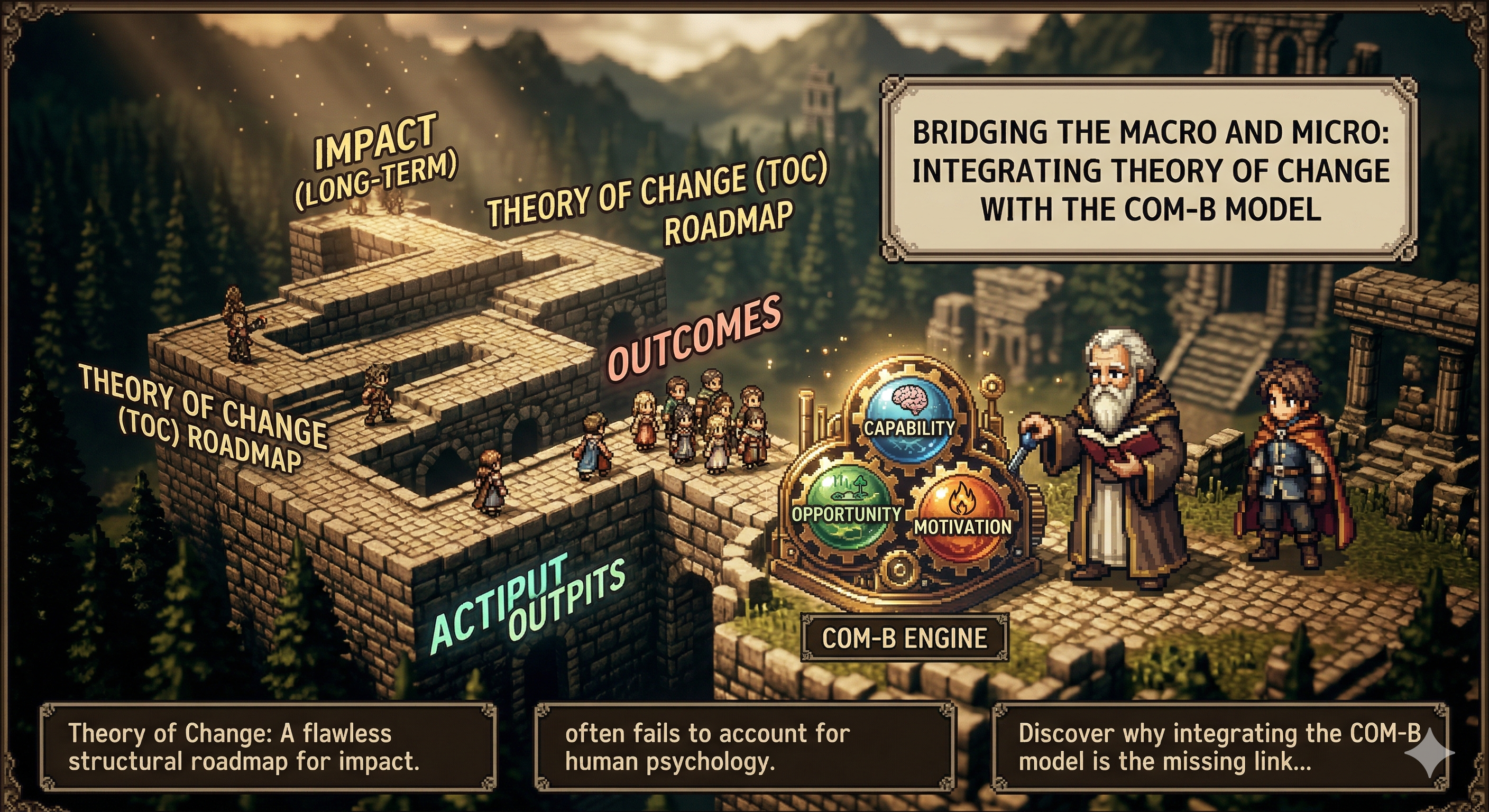
Historically, the Theory of Change (ToC), a concept formalized by Carol Weiss in 1995 [1.6], has been the gold standard for mapping out interventions. Weiss recognized that complex initiatives needed a "backward mapping" approach—starting with a long-term Impact and working backward to identify the necessary Outcomes, Outputs, and Activities. It provides a brilliant macro-level roadmap.
However, a roadmap does not drive the car. Traditional ToC frameworks often suffer from a critical vulnerability: they assume rational actors. They assume that if an Output (e.g., delivering a manual) is provided, the Outcome (e.g., the user adopting the practice) will naturally follow. This "Activity-First" assumption is where the logic breaks down.
The COM-B Engine
In 2011, Susan Michie, Maartje van Stralen, and Robert West published a foundational paper introducing the Behaviour Change Wheel (BCW) and the COM-B model. After analyzing 19 different, fragmented behavior change frameworks, they distilled the requirements for any human behavior down to three essential interacting conditions:
- Capability: The psychological and physical capacity to engage in the activity concerned.
- Opportunity: All the factors that lie outside the individual that make the behavior possible or prompt it.
- Motivation: All those brain processes that energize and direct behavior, not just goals and conscious decision-making, but habitual processes and emotional responding.
The Synthesis: Why They Need Each Other
If Theory of Change tells us what needs to happen (the sequence of events), COM-B tells us why the most critical step—human action—has not happened yet.
By overlaying COM-B onto the "Outcomes" phase of a Theory of Change, strategists can run a "Reality Check." Before a single dollar is spent on an Activity, you evaluate the target Outcome through the lens of Capability, Opportunity, and Motivation.
If a target audience lacks the financial resources to buy a subsidized water filter, their Opportunity is zero. Therefore, no amount of educational workshops (aimed at Capability) or marketing campaigns (aimed at Motivation) will result in behavior change. The ToC will fail because the intervention was mismatched with the behavioral bottleneck.
Conclusion
We must stop treating human behavior as a guaranteed byproduct of our project outputs. By integrating the macro-logic of ToC with the micro-diagnostics of COM-B, we move from hopeful speculation to precision architecture. We stop guessing what interventions to fund, and start designing solutions that actually fit the psychological and environmental realities of our target audience.